Home>Church>
Church News

St Etheldreda, Guilsborough
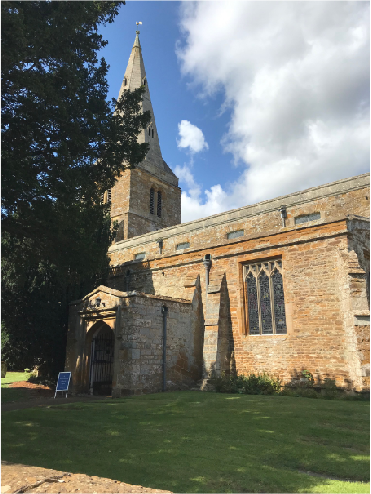
Guilsborough Church has been in existence for over 800 years and is possibly on the site of a Saxon church before that. Over the millennia it has been developed and extended a number of times and the internal layout has changed over the years with the addition of the two side aisles in the 14th and 15th centuries and the installation of a second altar in the area known as the Lady Chapel. The addition of seating, be it the Georgian box pews of which two examples still exist today, or Victorian pews in the central area of the church or nave or more modern pews built in the 1920s in the Lady Chapel and the north aisle where the band sits on Remembrance Sunday, also
The Uplands Group of Churches is in Vacancy, and we hope a new Rector will be appointed before too long.
The Uplands Group of Churches website has information of who to contact if there is anything you need through the church, e.g. Christenings, Weddings, Funerals or Pastoral Care etc.
demonstrates changes over time. Before this seating, people stood at services or sat on benches within the body of the church.
Today, we are looking at modernising the internal layout to make it more user-
Taking on board all those ideas and suggestions, we have prepared plans which show a raised floor, allowing underfloor heating, and therefore a level floor from the porch all through the centre of the church, the removal of some of the pews to free up space for other uses, a new servery and installation of a new toilet, relocation of the Rector’s office (vestry), new lighting and upgrading of the audio-
Plans have recently been published and shared at two public meetings demonstrating these ideas and are currently with the appropriate authorities for final approval. Once this has been achieved, it is our programme to start work on the physical project in early next year with completion in the summer. These plans can be viewed in the church during October.
A Thousand Years on the Hill: the story of Guilsborough Parish Church
Most of us walk past it every week. Fewer of us realise that the building at the top of the village has been standing, in one form or another, for something close to a thousand years — and that the ground beneath it may have been sacred for a good deal longer.
Before the record begins
Wetton's guidebook of 1849 notes that when an embankment west of the church was removed, around 1809, a quantity of human bones came to light. Local tradition put them down to a Roman burial place. There was certainly a Roman fort there, preceded by an Iron Age and Bronze Age fort. This was long before anyone locally wrote things down.
The first firm record comes in 1086. The Domesday Book lists at ‘Gisleburg’ -
Saxon clues in the stonework
Little Saxon fabric survives anywhere in England, but three details are suggestive. There is a small window cut from a single block of stone, with a narrow un-
Knights, dragons and the Seven Ages
The church we see today is largely 13th and 14th century. Warmer weather, better tools and a thriving wool trade filled parish coffers, and stone churches went up across the county. Around 1225 the church and its lands were given by William de Dive, Lord of the Manor of Nortoft, to the Knights Hospitaller — the Order of St John, still going today as the St John Ambulance. They appointed our first named vicar, Richard de Standen, and remained in charge of the church until the Order was dissolved in 1560.
Their masons left plenty behind. Look up and you will find sixty-
Reformation, riot and repair
Change came hard. The rood loft with its statues went under Elizabeth I. During the Civil War the glass was removed and any wall paintings whitewashed. Soon after, the dedication quietly changed from St Wilfrid — too Roman, too troublesome for Henry VIII’s and the Puritan’s taste — to St Etheldreda, the Saxon abbess of Ely.
The 19th century brought the sharpest conflict. A new roof in 1815 cost £850, levied on every villager, and the parish's reply to this and other ‘high church’ changes was blunt: the church was defaced in 1816, stones thrown at the roof during services in 1817, windows broken by Dissenters, and in 1833 the tithe barn was set alight. Calmer decades followed, and by the 1870s the church was gaining stained glass by William Morris and Edward Burne-
Still going
The gallery put up in 1700 came down in the 1920s, heating arrived in 1926, the Lady Chapel in 1965, and roof and structural repairs in the 2020s. Further improvements are planned for 2027. A thousand years on, the work never quite stops — the building continues to evolve to meet the times.
David O'Neil

Local news from the Northamptonshire villages of Cold Ashby,
Cottesbrooke, Creaton, Guilsborough, Hollowell & Teeton and Thornby.
Last updated Tuesday, September 29, 2026
Copy deadline for the Dec/Jan printed edition: Tuesday 27th October ‘26
menu